


When comparing an electric dirt bike with pedals vs without pedals, the difference seems straightforward: one has a pedal system and the other doesn't. In practice, however, pedals can affect much more than the appearance of the bike.
They can change how the rider interacts with the motor, how the bike is controlled at low speeds, how much mechanical maintenance is required, and how the vehicle may be classified under local regulations.
At the same time, pedals aren't the only thing that matters. Motor power, battery capacity, suspension, tires, brakes, weight, and intended riding environment all have a major effect on the riding experience.
That's why it's worth looking at the complete design rather than assuming that an electric dirt bike with pedals is simply a traditional e-bike with a more aggressive frame.
This guide explains the main differences between pedal-equipped and pedal-free electric dirt bikes, what each design is intended for, and what to check before buying.
What Is an Electric Dirt Bike With Pedals?
An electric dirt bike with pedals combines a motor-powered system with bicycle-style pedaling components.
Depending on the design, it may include a battery, electric motor, controller, crankset, chain or belt, pedals, and a conventional bicycle drivetrain. The rider can use electric power, human power, or both.
This makes the format more versatile than a completely pedal-free vehicle.
How Pedals Change the Riding Experience
Pedals give the rider another way to contribute power. On relatively easy terrain, a rider may pedal along with motor assistance. On climbs or when stronger acceleration is needed, the motor can provide most of the power.
Pedaling can also be useful at low speeds. It gives the rider a familiar way to add small amounts of forward movement rather than relying entirely on throttle input.
However, there's an important limitation.
An electric dirt bike can be considerably heavier than a conventional bicycle because of its large battery, motor, suspension, frame, and fat or knobby tires. So, while the bike may have functional pedals, riding it entirely without motor assistance may not feel anything like riding a lightweight mountain bike.
What Are Pedal-Equipped Models Designed For?
These models can appeal to riders who want a mixture of bicycle and dirt-bike characteristics.
They may suit riders who value:
- Active pedaling
- Bicycle-style controls
- Mixed riding conditions
- Low-speed maneuverability
- The option to contribute human power
- A more bicycle-oriented riding position
The exact benefits depend on the bike's geometry and drivetrain.
A heavy, high-powered model with pedals can still behave much more like a motorized off-road vehicle than a traditional bicycle.

What Is an Electric Dirt Bike Without Pedals?
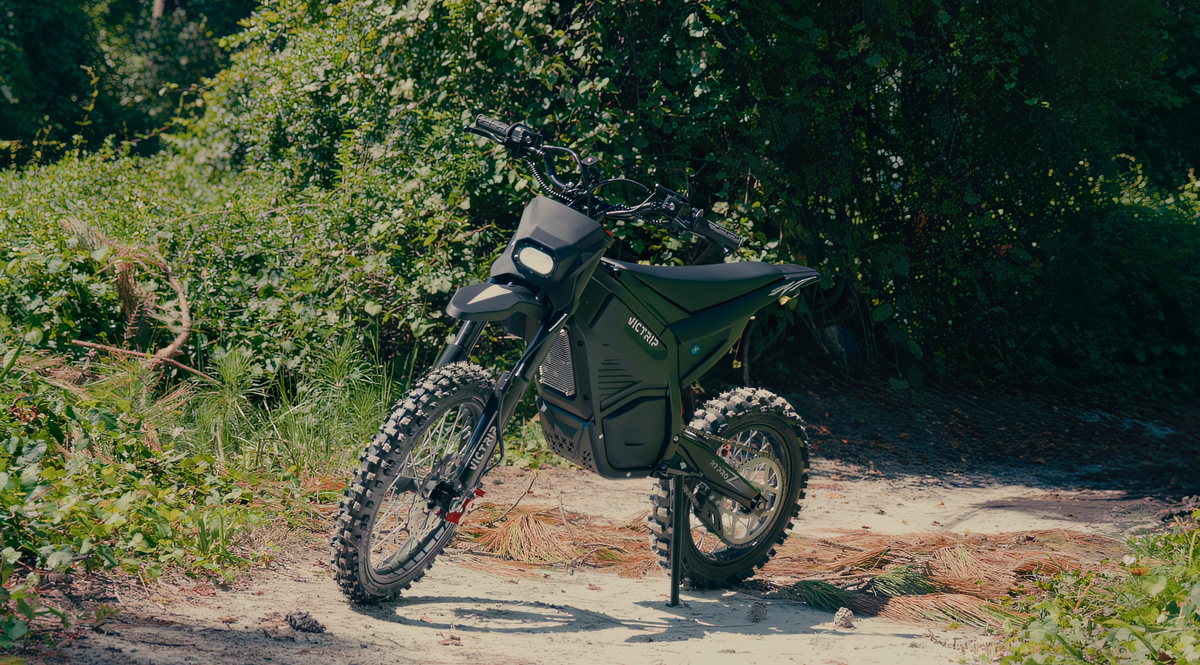
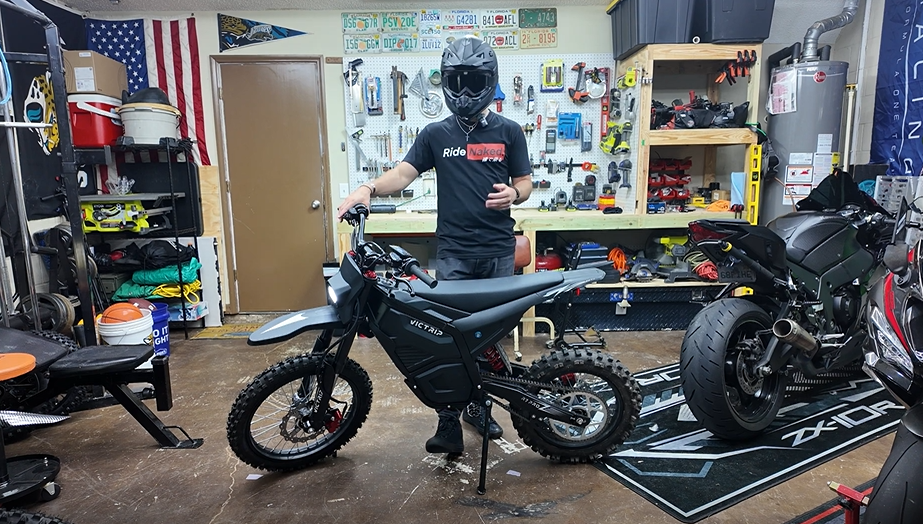
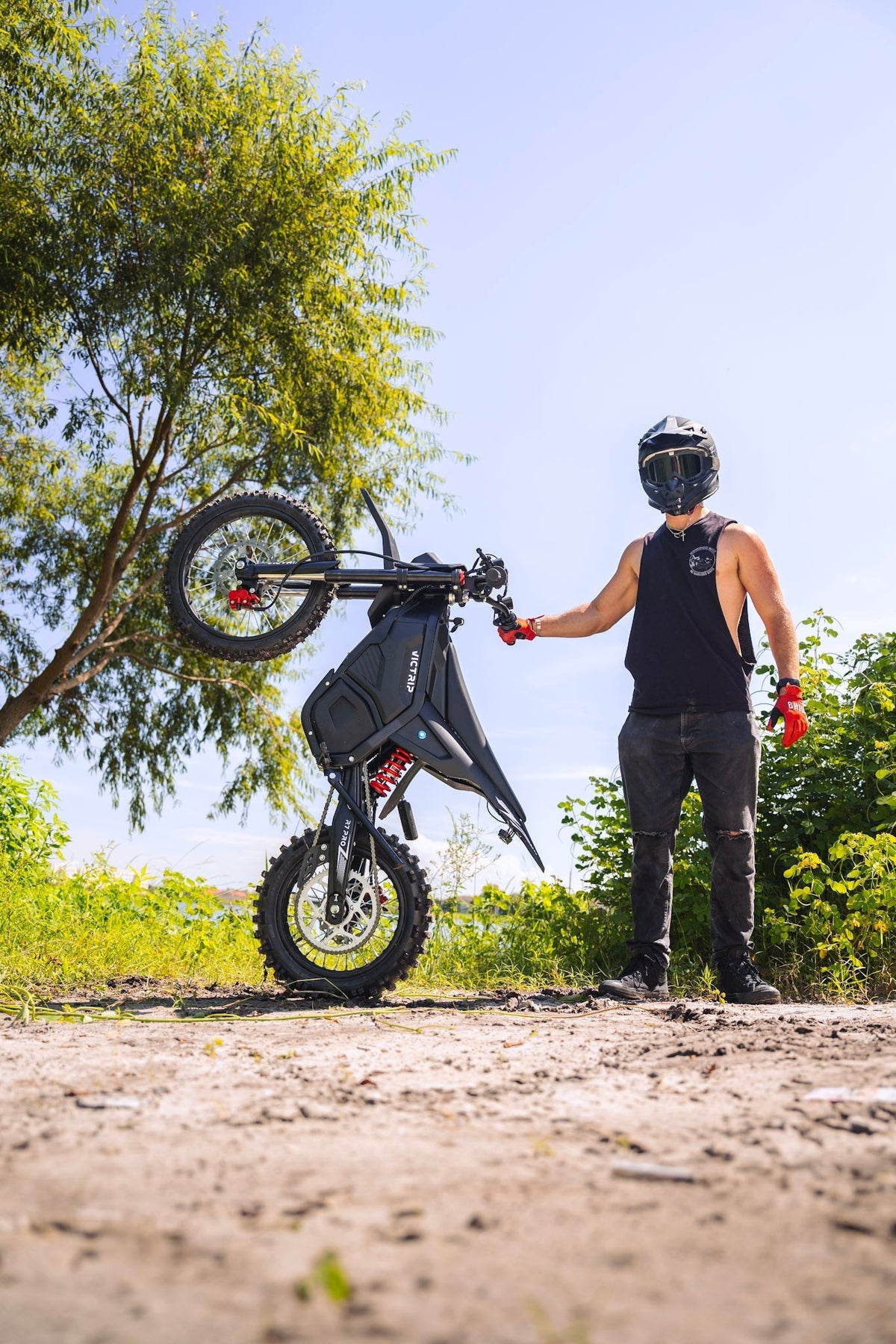
A pedal-free electric dirt bike is designed primarily around electric propulsion.
Instead of using a crank and pedals, the rider generally controls the vehicle with a throttle or electronic control system while placing their feet on dedicated footpegs.
This layout is closer to a traditional dirt bike or small electric motorcycle.
Why Remove the Pedals?
Removing the pedal system gives the manufacturer more freedom to design around motor-powered off-road riding.
The frame can be optimized around:
- Battery placement
- Motor position
- Ground clearance
- Suspension
- Footpeg location
- Frame strength
- Rider body position
- Off-road tire clearance
There are also fewer bicycle-specific drivetrain components.
A pedal-free design doesn't need conventional bicycle pedals, crank arms, bottom brackets, or a bicycle-style chainring simply to provide propulsion.
A More Dirt-Bike-Like Feel
For riders who spend most of their time on dirt roads, trails, private property, or other suitable off-road areas, a pedal-free design can feel more natural.
The rider can focus on throttle control, braking, body positioning, and terrain rather than coordinating pedal input with motor assistance.
That doesn't mean every pedal-free electric dirt bike is high performance. Models vary dramatically in motor output, battery capacity, suspension, dimensions, and intended rider.
The vehicle's complete specification matters more than whether pedals are present.
5 Key Differences Between Electric Dirt Bikes With and Without Pedals
The easiest way to compare the two designs is to look at the practical differences riders will notice.
1. Riding Experience and Rider Input
The first difference is how the rider provides input.
A pedal-equipped electric dirt bike gives the rider two sources of propulsion: human power and motor power.
A pedal-free model relies on motor power for forward movement.
This creates two different riding experiences.
With pedals, the rider can contribute power during easier sections of a ride. Pedaling may also feel more familiar to someone coming from a traditional bicycle or e-bike.
Without pedals, the controls tend to feel more like a dirt bike. The rider's feet remain on footpegs, allowing them to concentrate on balance, throttle control, braking, and body movement.
This distinction becomes more noticeable on uneven terrain.
When riding over bumps, loose dirt, or small obstacles, dirt-bike-style ergonomics can make it easier to shift body weight while standing on the footpegs.
On a pedal-equipped model, the rider may spend more time seated and interacting with the crank system.
Neither setup automatically provides a better experience. The right configuration depends on the type of riding you actually plan to do.
2. Motor Power and Off-Road Performance
Pedals don't determine how powerful an electric dirt bike is.
A pedal-equipped bike can have a modest motor, while a pedal-free bike can have a much more powerful system. The reverse is also possible.
When comparing performance, look beyond the pedal configuration and examine the complete electrical system.
Important specifications include:
- Rated motor power
- Peak motor power
- Battery voltage
- Battery capacity
- Controller output
- Torque
- Maximum assisted speed
For off-road riding, power delivery can be more important than the headline top-speed number.
Strong torque can help with hills, loose surfaces, and acceleration out of corners. Battery voltage and controller performance also affect how consistently the motor can deliver power.
The chassis matters too.
A powerful motor needs suitable brakes, tires, suspension, and frame construction. Otherwise, adding more motor output doesn't necessarily create a better-balanced machine.
VICTRIP's current electric dirt bike guides similarly emphasize that motor, battery, suspension, brakes, tires, and rider fit need to be considered together rather than judging a bike from motor wattage alone.
3. Range and Battery Use
Pedals can influence energy consumption, but they don't guarantee a longer range.
If a rider actively contributes human power, the electric motor may not need to provide as much assistance in certain situations. That can reduce energy consumption.
However, electric dirt bike range is affected by many other variables:
- Battery size
- Motor power
- Rider weight
- Riding speed
- Terrain
- Tire pressure
- Wind
- Temperature
- Acceleration
- Riding mode
For example, climbing loose trails at high speed can use significantly more energy than riding steadily on flat ground.
Battery capacity is therefore more useful for comparison than simply asking whether a bike has pedals.
A battery's energy can be estimated using voltage multiplied by amp-hours. For example, a 48V 20Ah battery has approximately 960Wh of energy.
A 72V 25Ah battery has approximately 1,800Wh.
Actual range will still vary, but watt-hours provide a useful starting point for comparing battery capacity.
4. Maintenance and Mechanical Components
Pedals add mechanical components.
A pedal-equipped electric dirt bike may have:
- Pedals
- Crank arms
- Bottom bracket
- Chainring
- Chain
- Rear sprocket
- Derailleur or gearing
These parts need occasional inspection and maintenance.
A pedal-free electric dirt bike removes many of these bicycle-specific components. That can simplify the mechanical layout, although the rest of the bike still requires regular care.
Both types need attention to components such as:
| Component | What to Check |
|---|---|
| Brakes | Pad wear, rotor condition, lever feel |
| Tires | Pressure, tread, cuts, and damage |
| Wheels | Loose spokes, bearings, alignment |
| Suspension | Leaks, unusual play, damage |
| Fasteners | Loose bolts after rough riding |
| Battery | Damage, connections, charging behavior |
| Electrical system | Wires, connectors, throttle function |
Off-road riding can put additional stress on the bike because of impacts, vibration, mud, water, and dust.
So don't assume a pedal-free electric dirt bike is maintenance-free. It simply has a different set of components to maintain.
5. Legal Classification and Where You Can Ride
This is one of the most important differences to understand.
Pedals can be relevant to how an electric vehicle is classified, but adding pedals doesn't automatically make a powerful electric dirt bike a legal e-bike.
In the United States, the federal low-speed e-bike definition includes fully operable pedals, an electric motor of less than 750 watts, and a maximum speed of less than 20 mph when powered solely by the motor under the specified test conditions.
PeopleForBikes also notes that electric bicycle laws vary by state and that vehicles exceeding the applicable power or speed limits may fall outside the three-class e-bike framework.
That means a high-powered electric dirt bike with pedals shouldn't automatically be treated as a conventional e-bike.
The same issue applies to trail access.
A place that permits bicycles or certain classes of e-bikes may not necessarily permit a high-powered electric dirt bike. Land managers can also establish their own access rules.
Before riding, check the laws and rules that apply to your location and the exact vehicle.
U.S. Consumer Product Safety Commission — Bicycle Requirements
Which Design Fits Your Riding Style?
The best way to narrow the choice is to start with your riding habits rather than the appearance of the bike.
A Pedal-Equipped Model May Make Sense If You Want More Versatility
A bike with pedals can be useful when you want the option to combine human effort with electric power.
This may appeal to riders who:
- Like to pedal
- Want a bicycle-style experience
- Ride at moderate speeds
- Spend time on flatter terrain
- Want another way to move the bike
- Prefer a hybrid bicycle/off-road design
Remember that vehicle weight matters. A heavy electric dirt bike may be difficult to pedal for long distances even when the pedals are fully functional.
A Pedal-Free Model May Make Sense for Dedicated Off-Road Riding
A pedal-free design may be more suitable when the primary purpose is motor-powered recreational riding.
This can be relevant when your priorities include:
- Dirt-bike ergonomics
- Footpeg-based riding
- Strong motor performance
- Off-road suspension
- Knobby tires
- Aggressive trail riding
Instead of asking which design is universally better, consider where you'll ride and how you expect to control the bike.
What Should You Check Before Buying?
Before choosing between a pedal and pedal-free electric dirt bike, compare these factors.
Motor and Battery
Check rated and peak power, battery voltage, amp-hours, and overall battery capacity.
Don't rely on a single wattage number.
Rider Fit
Look at seat height, handlebar position, wheel size, frame dimensions, weight capacity, and recommended rider size.
A bike that is too large or too powerful can be difficult to control.
Brakes and Suspension
These components become increasingly important as vehicle weight and performance increase.
Disc brakes and quality suspension can contribute to better control, especially on uneven surfaces.
Tires
Consider whether the tires are designed for pavement, gravel, dirt, mud, or mixed surfaces.
Tire width and tread pattern can significantly affect traction and handling.
Riding Location
Decide whether you'll ride on private property, designated trails, dirt roads, or public streets.
Then check whether that specific type of vehicle is permitted.
Replacement Parts and Support
Also consider long-term ownership.
Before buying, check whether the manufacturer provides replacement batteries, tires, brake components, chargers, and other service parts.
A lower purchase price isn't necessarily useful if important replacement parts are difficult to find later.
FAQs
1. Can you pedal an electric dirt bike without motor power?
Yes, if the bike has functional pedals. However, the vehicle's weight, tire size, gearing, and terrain can make manual pedaling much harder than on a conventional bicycle.
2. Does having pedals make an electric dirt bike an e-bike?
Not automatically.
In the United States, applicable definitions can include requirements for fully operable pedals, motor power, and speed. State and local rules may also differ.
3. Are electric dirt bikes without pedals faster?
Not necessarily.
Removing pedals doesn't determine top speed. Motor output, controller settings, battery voltage, gearing, weight, tires, and other components have a much larger influence on performance.
4. Do pedals increase electric dirt bike range?
Pedaling can reduce the amount of motor assistance required in some situations, which may reduce energy consumption. However, actual range depends on battery capacity, terrain, speed, rider weight, temperature, and riding style.
5. Which is easier to maintain: an electric dirt bike with pedals or without?
A pedal-free bike generally has fewer bicycle-specific drivetrain components. However, both types require regular maintenance of brakes, tires, wheels, suspension, fasteners, battery connections, and electrical components.
6. Can a pedal-equipped electric dirt bike be used on bicycle trails?
It depends on the vehicle and the rules for that trail.
Don't assume that the presence of pedals automatically gives an electric dirt bike access to every bicycle trail. Check the rules of the land manager or trail operator before riding.
7. What matters more than pedals when buying an electric dirt bike?
Motor power, battery capacity, brakes, suspension, tire design, rider fit, vehicle weight, intended terrain, and local regulations can all be more important than the simple presence or absence of pedals.
Final Thoughts
The electric dirt bike with pedals vs without pedals question comes down to how you want to ride.
Pedal-equipped models provide an additional way to contribute power and can offer a more bicycle-oriented experience. Pedal-free models focus more directly on motor-powered riding and can use a layout that's closer to a traditional dirt bike.
But pedals aren't the deciding factor for every buyer.
Motor performance, battery capacity, suspension, braking, tires, vehicle weight, rider fit, and intended riding environment all deserve attention. Legal classification matters too, particularly for powerful models that may exceed the specifications associated with low-speed electric bicycles.
The simplest approach is to start with your actual riding environment. Think about whether you'll be pedaling, using the throttle, riding technical trails, cruising on private property, or looking for a more motorcycle-style experience.
Once you know that, comparing the right type of electric dirt bike becomes much easier.
Share:
Electric Dirt Bike Charging Guide: How Long Does It Take?