

When comparing an electric dirt bike vs ATV, the biggest difference isn't simply two wheels versus four. The two vehicle types are designed around very different riding experiences.
An electric dirt bike is usually lighter, narrower, and more motorcycle-like. It lets the rider lean into turns, move around obstacles, and choose lines through narrow sections of a trail. An ATV, or all-terrain vehicle, uses four wheels and a wider chassis to provide a more planted feel.
For trail riding, neither is automatically better. The right choice depends on the terrain, your riding experience, how much maneuverability you want, and how you plan to use the vehicle.
Here's a quick comparison:
| Feature | Electric Dirt Bike | ATV |
| Wheels | 2 | 4 |
| Handling | Agile and lean-based | Stable and planted |
| Trail width | Usually narrower | Usually wider |
| Riding position | Seated or standing | Mostly seated |
| Tight trails | Excellent | More difficult |
| Loose terrain | Depends on tires and rider skill | Strong stability |
| Maintenance | Generally simpler | More mechanical components |
| Noise | Very low | Usually higher |
| Learning curve | Requires balance | Easier to balance at low speeds |
| Best for | Active trail riding | Utility and recreational riding |
What Is an Electric Dirt Bike?
An electric dirt bike is an off-road motorcycle powered by a battery and electric motor rather than a gasoline engine.

Modern electric dirt bikes can deliver strong low-speed torque, quick throttle response, and enough suspension travel and ground clearance for dirt trails. Depending on the model, they can be designed for casual trail riding, technical terrain, motocross-style riding, or more aggressive off-road use.
One major advantage is the riding position. Riders can shift their weight forward, backward, or from side to side while navigating obstacles. This makes an electric dirt bike particularly engaging on uneven trails.
There’s also no engine noise or exhaust, which can make electric bikes appealing for riders who prefer a quieter outdoor experience.
However, two wheels require more active control. The rider needs to understand balance, braking, throttle control, and body positioning.
What Is an ATV?
An ATV uses four wheels and a wider chassis to create a stable platform for off-road travel.
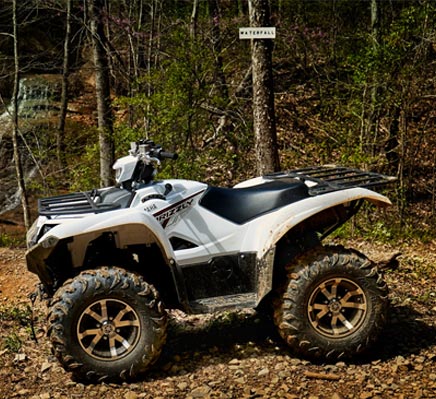
ATVs are available in many configurations. Some are designed mainly for recreation, while others are built for farming, hauling, hunting, or utility work. That versatility is one reason ATVs remain popular.
For trail riding, the four-wheel design provides a strong sense of stability. You don't need to balance the vehicle in the same way you would with a dirt bike.
However, an ATV's wider body can become a disadvantage on narrow trails. Tight turns, trees, rocks, and other obstacles can require more planning.
The ATV Safety Institute recommends riding only on designated trails and at a safe speed, while also emphasizing appropriate protective equipment and rider training.
Electric Dirt Bike vs ATV: 7 Key Differences
1. Handling and Maneuverability
This is probably the biggest difference.
An electric dirt bike can lean into corners and change direction quickly. Its narrow profile also makes it easier to move through tighter spaces.
An ATV doesn't lean in the same way. Instead, the rider steers a four-wheel platform. This can feel very stable, but the wider vehicle may need more room for turns.
For technical trails with narrow gaps, sharp turns, and frequent obstacles, the electric dirt bike has a clear advantage in maneuverability.
2. Trail Terrain and Traction
Both vehicles can perform well off-road, but their behavior differs.
Electric dirt bikes rely heavily on tire selection, suspension, and rider technique. A well-designed dirt bike can move over rocks, roots, dirt, and uneven ground while allowing the rider to actively shift weight.
ATVs have four contact points with the ground, which can make them feel more secure on loose or uneven surfaces.
Still, four wheels don't automatically mean better traction. Tire tread, tire pressure, suspension setup, vehicle weight, and rider input all matter.
3. Power and Acceleration
Electric motors deliver torque almost immediately, which can make electric dirt bikes feel responsive when accelerating out of corners or climbing moderate hills.
ATVs can also offer substantial power, especially larger recreational models. Gas-powered ATVs may have an advantage for very long rides where quick refueling is important, while electric models depend on battery capacity and charging access.
For trail riding, raw horsepower isn't everything. Smooth throttle control can be more useful than simply having the highest peak output.
4. Riding Position and Comfort
ATVs are generally designed around a seated riding position. This can be comfortable for riders who prefer a relaxed posture.
Dirt bikes offer more flexibility. Riders can sit on smoother sections and stand on the footpegs when terrain becomes rough.
Standing allows the rider to use their legs as part of the suspension system and shift body weight more effectively.
That active riding style can be more tiring, though. If your idea of trail riding is several hours of relaxed cruising, an ATV may be more comfortable.
5. Size and Trail Access
A typical electric dirt bike has a major advantage when trail width becomes limited.
Its narrow frame can fit through spaces that would be difficult or impossible for a wider ATV. This can make dirt bikes particularly enjoyable on wooded trails and technical routes.
An ATV's larger footprint can be useful on open terrain, but it requires more space to turn and maneuver.
Before riding either vehicle, check the rules for the specific trail. Access restrictions can differ by location and vehicle type.
6. Maintenance and Ownership
Electric dirt bikes generally have fewer mechanical components than gas-powered ATVs.
There is no engine oil, spark plug, exhaust system, or fuel system to maintain. Routine care still matters, including checking brakes, tires, chain or drivetrain components, suspension hardware, and electrical connections.
ATVs can require more traditional mechanical maintenance. Gas models need oil and filter servicing, fuel-system care, and other engine-related maintenance.
That doesn't mean an ATV is difficult to maintain. It simply has a different maintenance profile.
7. Noise and Riding Experience
Electric dirt bikes are extremely quiet compared with gasoline-powered off-road vehicles.
That's useful for riders who prefer a more peaceful experience and can also make conversations easier when riding with others.
However, quiet doesn't mean unrestricted. Riders still need to follow local trail rules and respect land managers, wildlife, hikers, and other trail users.
The ATV Safety Institute also recommends staying on designated trails and respecting closures and trail restrictions.
Which Is Better for Tight and Technical Trails?
For narrow, technical trails, an electric dirt bike is usually the better choice.
The narrow chassis makes it easier to navigate between trees and around obstacles. The rider can also shift body weight quickly when climbing, descending, or turning.
A dirt bike can be especially fun when the trail itself is the challenge.
That said, beginners shouldn't assume that a smaller vehicle is automatically easier. Two-wheel riding requires balance and coordination. Start slowly and practice basic braking, steering, and throttle control before attempting difficult terrain.
Which Is Better for Open Trails?
For wide, open trails, the answer becomes less obvious.
An ATV can be comfortable for riders who want stability and a relaxed seated position. It's also useful when carrying gear or when the vehicle has a broader utility purpose.
An electric dirt bike can still be excellent for open trails, especially for riders who enjoy an active and responsive riding experience.
So, if the trail is wide and relatively smooth, choose based more on your preferred riding style than on the terrain itself.
Where Do Electric Dirt Bikes Like the VICTRIP R7 Fit?
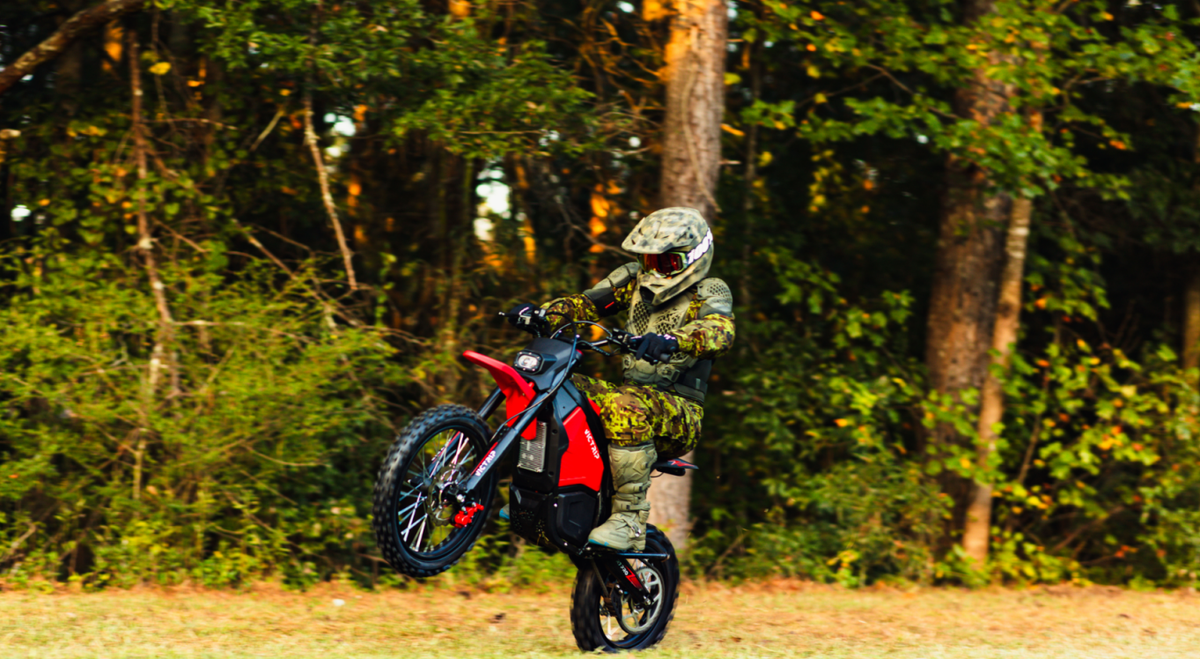
For riders looking for a more performance-oriented electric dirt bike, models such as the VICTRIP R7 and R7 Pro demonstrate how electric power can be used for more demanding off-road riding.
The R7 platform is aimed at riders who want a motorcycle-style trail experience rather than the utility-focused design of an ATV. The R7 Pro, in particular, is built around higher-output performance and aggressive off-road use.
The important point isn't simply the motor rating. Trail performance also depends on suspension, tires, braking, chassis geometry, ground clearance, battery capacity, and rider skill.
That's why comparing vehicles only by peak wattage can be misleading.
TOP PICK

VICTRIP®R7 Pro Fastest Off Road Dirt Bike
$1999.00
Electric Dirt Bike vs ATV: Which Is Easier for Beginners?
For many beginners, an ATV may initially feel easier because the four-wheel platform doesn't require the same balance as a dirt bike.
But that doesn't mean an ATV requires no training.
The ATV Safety Institute offers both online and hands-on rider training covering basic skills such as starting, stopping, turning, hill riding, emergency braking, and obstacle negotiation.
An electric dirt bike requires riders to learn balance and body positioning, but those skills can become natural with practice.
The best approach is to start on easy terrain and gradually increase difficulty.
Safety Considerations for Trail Riding
Whatever you choose, safety should come before speed.
Before riding:
- Wear an appropriate helmet and protective equipment.
- Check tire condition and pressure.
- Test the brakes and throttle.
- Inspect major fasteners and controls.
- Make sure the battery is adequately charged on an electric model.
- Ride only where the vehicle is permitted.
- Start at a speed that matches your experience.
- Avoid unfamiliar obstacles at high speed.
The ATV Safety Institute specifically recommends helmets, goggles, long sleeves, long pants, gloves, and over-the-ankle boots for ATV riders.
For additional ATV-specific training and riding guidance, see the ATV Safety Institute.
Electric Dirt Bike or ATV: Which Should You Choose?
Choose an electric dirt bike if you want:
- Agile handling
- Narrow-trail capability
- Active riding
- Quick electric acceleration
- A quieter riding experience
- A motorcycle-style feel
Choose an ATV if you want:
- Four-wheel stability
- A primarily seated riding position
- More utility-focused capability
- Easier low-speed balance
- A platform that can carry more equipment
There's no universal winner.
For riders who see trail riding as an active sport and enjoy picking lines through challenging terrain, an electric dirt bike is often the more exciting option.
For riders who prioritize stability, comfort, and utility, an ATV may make more sense.
FAQs
Is an electric dirt bike better than an ATV for trail riding?
It depends on the trail and your riding style. Electric dirt bikes are generally better for narrow and technical trails, while ATVs can be better for riders who prefer stability and a seated riding position.
Are electric dirt bikes good for off-road trails?
Yes. Models designed for off-road use can be well suited to dirt, gravel, hills, rocks, and other trail surfaces. Tires, suspension, ground clearance, battery capacity, and rider skill all affect performance.
Is an ATV easier to ride than an electric dirt bike?
An ATV can feel easier initially because it has four wheels and doesn't require the same balance. However, proper ATV training is still important, particularly for new riders.
Can an electric dirt bike go on ATV trails?
Sometimes, but it depends on the trail and local regulations. Some trails allow multiple types of off-highway vehicles, while others have specific restrictions. Always check the rules before riding.
Are electric dirt bikes easier to maintain than ATVs?
Compared with gasoline-powered ATVs, electric dirt bikes generally have fewer engine-related maintenance requirements. However, tires, brakes, suspension, drivetrain components, and electrical systems still require regular inspection.
Final Verdict: Electric Dirt Bike vs ATV
The electric dirt bike vs ATV decision comes down to what you want from trail riding.
If your priority is maneuverability, active riding, narrow trails, and a quiet electric powertrain, an electric dirt bike is a strong choice.
If stability, comfort, carrying capability, and a four-wheel platform matter more, an ATV may be the better fit.
Instead of asking which vehicle is universally better, ask which one matches your trails and riding style. Once you make that distinction, the choice becomes much easier.
We recommend for you:
- 48V vs 60V vs 72V Electric Dirt Bikes: What's the Difference?
- Electric Dirt Bike Troubleshooting: Common Problems and Solutions
- Electric Dirt Bike Acceleration: What Determines How Fast It Feels?
-
Electric Dirt Bike vs Electric Motorcycle: What's the Difference?
- How Fast Can a 4000W Electric Dirt Bike Go?
Share:
How Long Does It Take for an Electric Bike to Pay for Itself?
Top Youth Electric Bikes for Beginners: Features Parents Should Know